
Final Expense Agent Training
The final expense sales script.
Built for real conversations.
A strong final expense script is not a collection of lines to read word for word. It is a structured framework that helps an agent open the conversation, understand the client's needs, present coverage clearly, navigate concerns, and confidently move toward the next step.
Introduction → Discovery → Presentation → Decision
- Opening
- Discovery
- Presentation
- Objections
- Closing
- Follow-Up
The framework
A script should guide the conversation.
Reading words off a page is not the same as learning how to sell. Strong agents understand the purpose behind each stage of the conversation so they can listen, adapt, and still maintain structure.
What a script should not do
- Make the agent sound robotic
- Replace active listening
- Pressure the prospect
- Ignore what the client is saying
- Turn every call into the exact same conversation
What a script should do
- Create consistency
- Reduce hesitation
- Keep conversations organized
- Make important questions easier to remember
- Help new agents learn a repeatable process
The final expense conversation
Six stages. One connected process.
Script stage 01
The opening.
Earn the next 30 seconds.
The purpose of the opening is not to immediately sell a policy. It establishes who the agent is, why the conversation is happening, enough context for the prospect to understand the call, and permission to continue.
Clear
Do not make the prospect guess why you are calling.
Calm
A rushed opening creates unnecessary resistance.
Conversational
The opening should sound like a person speaking, not a recording.
- Agent
Hi, this is [name] with Final Expense Elite. I'm following up on the final expense information you requested. Do you have a couple of minutes?
Script stage 02
Discovery.
Ask before you present.
Before discussing coverage options, the agent needs enough information to understand what the prospect is trying to accomplish — without turning the call into an interrogation.
Why now?
What led the prospect to have the conversation?
Current coverage
What protection already exists?
Priorities
What does the prospect want the policy to accomplish?
People
Who would be financially affected?
Comfort
What type of monthly commitment feels realistic?
Next step
What would the prospect need to feel comfortable moving forward?
The best script still requires listening.
The purpose of discovery is not simply to collect answers. It is to understand what matters enough that the coverage presentation can be relevant.
- 01Ask
- 02Listen
- 03Clarify
- 04Confirm
- Agent
Do you have any life insurance in place right now?
- Prospect
A small policy through my old job, but I'm not sure it's enough.
Script stage 03
Present the coverage.
Connect the policy to the need.
The presentation should connect the options being discussed to the needs uncovered during discovery.
- 01What we heard
- 02What matters
- 03Coverage options
- 04Client decision
Final Expense Elite training
The 3-Policy Strategy.
The 3-Policy Strategy teaches you to present multiple coverage options clearly, rather than forcing a prospect into a single price point.
Option
A
Higher coverage
Option
B
Balanced coverage
Option
C
Lower monthly commitment
Keep it clear
Explain the differences between options without overwhelming the client.
Connect it back
Tie recommendations to what was learned during discovery.
Let them compare
Give the prospect enough clarity to evaluate the available choices.
Script stage 04
When the answer isn't yes yet.
Questions and hesitation are part of insurance conversations. Objection handling is not about arguing with a prospect. It is about understanding what is creating uncertainty and determining whether there is a legitimate path forward.
- “I'm not interested.”
- “I already have insurance.”
- “I need to think about it.”
- “I need to talk to my family.”
- “That's too expensive.”
- “Call me another time.”
Listen. Clarify. Respond. Return.
- 01
Listen
Let the prospect finish before reacting. - 02
Clarify
Understand what the concern actually means. - 03
Respond
Address the actual issue rather than giving a canned rebuttal. - 04
Return
Determine whether it makes sense to continue the conversation.
Sales ethics
A script is not permission to ignore the client.
Good objection handling separates uncertainty, questions, and timing concerns from a clear request to stop. When someone clearly declines or asks to end the call, the professional response is to respect it.
Script stage 05
Ask for the decision.
A strong conversation eventually needs a clear next step. The close should feel like a natural continuation of the needs, priorities, and coverage options already discussed — not artificial pressure.
- 01Confirm the selected direction
- 02Clarify any remaining question
- 03Next step: the application
Be direct
Do not make the client guess what comes next.
Be calm
Confidence does not require urgency theater.
Be accurate
Never misrepresent coverage, pricing, approval, carrier terms, or policy details to force a decision.
- Agent
It sounds like the middle option fits what you described. Is there anything you'd want me to clarify before we start the application?
- Prospect
No, I think that one makes sense.
After the decision
- 01Decision
- 02Application
- 03Underwriting / carrier process
- 04Policy outcome
Applications go through the carrier's own process. Not every application is approved, and coverage isn't active until carrier requirements are met.
Script stage 06
The conversation doesn't always end on the first call.
Legitimate prospects may need a scheduled callback, more information, a family discussion, follow-up after an interrupted call, or further clarification.
- 01Contact
- 02Disposition
- 03Schedule
- 04Follow up
- 05Outcome
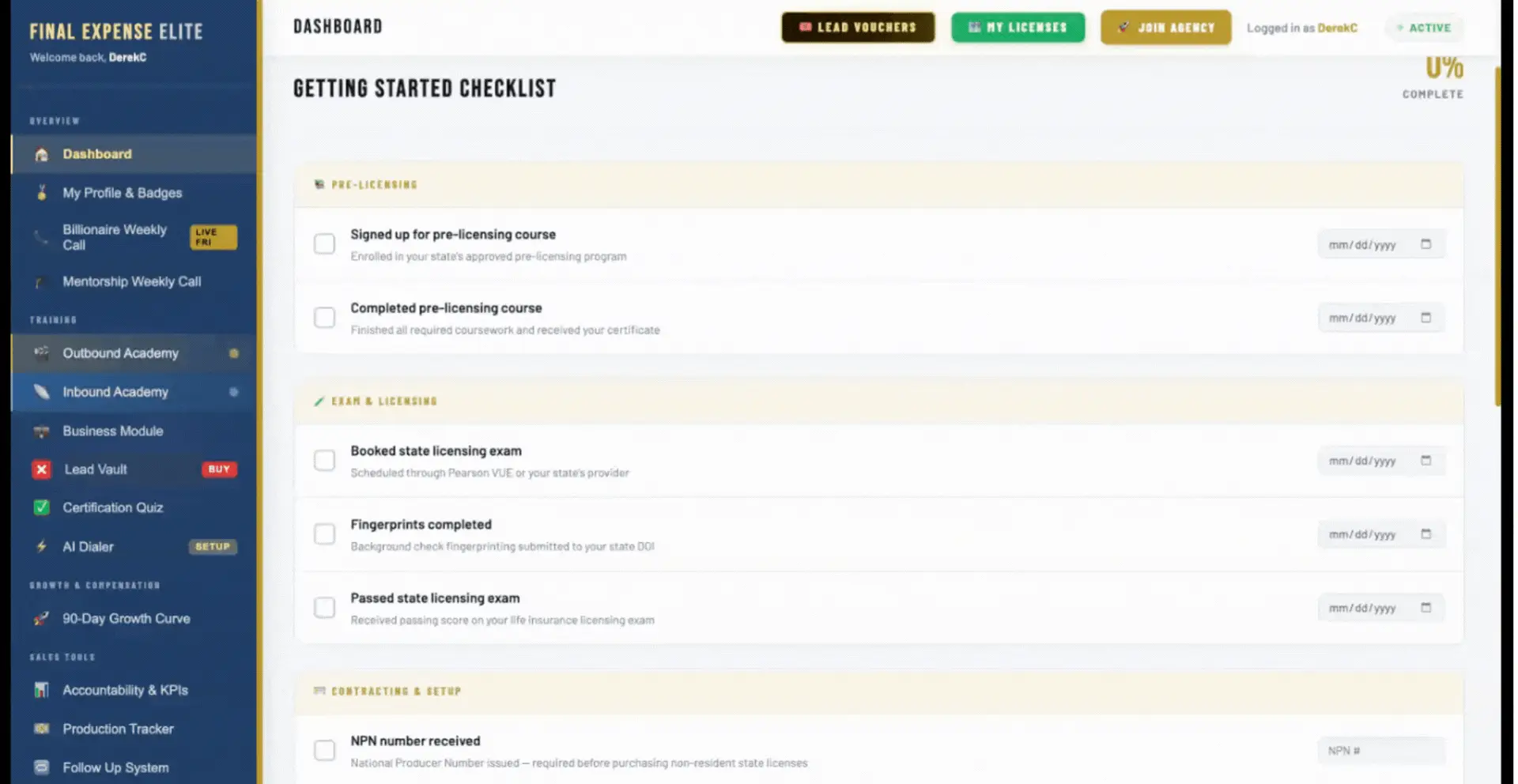
Agent Dashboard
Don't manage follow-up from memory.
The Agent Dashboard keeps training, lead flow, production stats and support in one place.
Recap
The complete final expense conversation.
- 01Open
- 02Discover
- 03Understand the need
- 04Present options
- 05Answer questions
- 06Ask for the decision
- 07Application
- 08Follow up
Don't just memorize the words. Understand the conversation.
Reading a script
- Focuses on the next line
- Can sound mechanical
- Struggles when the conversation changes
- Often ignores context
Understanding the framework
- Knows the goal of each stage
- Listens to the prospect
- Can adapt while staying structured
- Understands where the conversation should go next
How agents improve
The script is learned through repetition.
Reading the script once is not training. Improvement comes from repeated application and feedback.
- 01Learn
- 02Practice
- 03Roleplay
- 04Dial
- 05Review
- 06Refine
- 07Repeat
Interactive training example
See each stage in a conversation.
An educational visualization — not a live coaching feature.
Training example
- Agent
Hi, this is [name] with Final Expense Elite. I'm following up on the final expense information you requested. Do you have a couple of minutes?
- Prospect
I guess so, what's this about?
- Agent
I'll keep it short — I just want to understand what you were looking for so I don't waste your time.
- Current stage
- Opening
- Goal
- Make the reason for the call clear and ask permission to continue.
- Listen for
- Whether now is a good time
- Recognition of the inquiry
- Tone and pace
- Next stage
- Discovery
Call review
After the call, the training continues.
Agents improve faster when they can identify exactly where conversations are breaking down instead of simply making more calls and hoping for a different result.
- Opening
- Discovery
- Clarity
- Presentation
- Objections
- Closing
- Follow-Up
What to avoid
The script is a tool. Don't let it become a crutch.
- 01
Reading too fast
- 02
Not listening
- 03
Skipping discovery
- 04
Presenting too early
- 05
Arguing with objections
- 06
Rushing the close
New to final expense?
Start with structure.
New agents may benefit from following the framework more closely while they learn the conversation. Over time, the goal is to understand the process well enough to sound natural rather than scripted.
Already selling?
Use the framework to find the leaks.
Where prospects disengage
Which discovery questions are being missed
Where objections occur
How clearly options are being presented
Whether follow-up is consistent
Where this fits
Script training is part of a bigger system.
Days 1–30
Foundation
Script training
Days 31–60
Volume
Live calls + objection handling
Days 61–90
Scale
Call review + advanced strategy
Technology
Training meets the live call.
The script is one part of the system. Final Expense Elite connects training with the tools agents use to reach prospects, organize conversations, manage follow-up, and review performance.
- 01Lead
- 02AI Dialer
- 03Agent conversation
- 04CRM
- 05Follow-up
- 06Performance review
Keep training
Master the entire sales conversation.
FAQ
Final expense sales script questions
Should final expense agents read a script word for word?
Not indefinitely. New agents may follow the framework closely while they learn, but the goal is to understand the purpose of each stage well enough to listen, adapt, and still keep the conversation structured.
What should a final expense sales script include?
A clear opening, discovery questions, a coverage presentation tied to what you learned, a way to work through questions and concerns, a direct ask for the decision, the application step, and follow-up.
How do new agents practice the script?
Through repetition: learn the stages, practice and roleplay, take live calls, review what happened, and refine. Reading the script once is not training.
How does discovery fit into the script?
Discovery comes before any coverage discussion. It uncovers existing coverage, priorities, the people who would be affected, and what feels like a realistic monthly commitment, so the presentation is relevant.
How do you present final expense coverage options?
Connect each option back to what the prospect told you, keep the differences clear, and give them enough clarity to compare. Final Expense Elite teaches this through the 3-Policy Strategy.
How should agents handle objections?
Listen, clarify what the concern actually means, respond to the real issue, and decide whether it makes sense to continue. A clear request to stop is always respected.
What is the 3-Policy Strategy?
A Final Expense Elite training framework for presenting multiple coverage options clearly, rather than forcing a prospect into a single price point.
How does the script work with virtual telesales?
Calls run through the browser-based AI dialer, and scripts are available inside the Agent Dashboard while you dial, so the guidance is always one click away.
Does Final Expense Elite provide sales scripts?
Yes. Final Expense Elite agents use the same final expense sales scripts our top producers use, from the first “Hello” to the final signature, inside the Agent Dashboard.
How does script training fit into the 90-Day Roadmap?
Script training is part of the Foundation phase (Days 1–30). Live calls and objection handling build in Days 31–60, and call review and advanced strategy follow in Days 61–90.
Put the training into practice
Learn the conversation. Build the repetitions. Improve every call.
Final Expense Elite combines sales training with the technology, lead infrastructure, licensing resources, and agent systems needed to put that training into practice.